

Robot vs Cleaner: What Should Each Actually Be Doing?
Commercial cleaning robots aren’t here to replace cleaners. They’re here to change what we ask cleaners to spend their valuable time doing.
One of the biggest misconceptions we hear when talking about cleaning robotics is:
“So, is the robot going to replace our cleaner?”
Usually, no.
We think that's the wrong way to look at cleaning automation.
The better question is:
What should a robot be doing, and what should a cleaner be doing?
Because there are things robots can do more consistently than people. And there are important cleaning tasks where a skilled person is still far better than a robot.
The smartest cleaning programmes combine the two.
Not All Cleaning Hours Are Equal
Think about a cleaner working a four-hour shift.
They have four hours to get through everything on their Schedule of Duties.
Bathrooms need cleaning. Bins need emptying. Kitchens need attention. Consumables need restocking. Touchpoints need wiping. Floors need vacuuming and mopping.
And, ultimately, they need to get the job finished within the hours allocated.
That naturally creates competing priorities.
If a bathroom takes longer than expected, something else has to be completed faster. If the cleaner is running behind, they still need to finish their shift.
This is one of the areas where robots and people operate very differently.
A robot isn't trying to finish its shift and get home.
It follows its programmed map, route and cleaning schedule and systematically works through the areas it has been assigned.
That's incredibly useful for repetitive floor cleaning.
Consistency Is Where Robots Shine
Vacuuming the same 100-metre corridor every night isn't complicated work, but doing it thoroughly and consistently takes time.
The same applies to scrubbing hundreds or thousands of square metres of hard flooring.
People naturally vary.
One cleaner might vacuum an area slightly differently from another. Someone may move faster when they're short on time. An area that looks clean may get less attention than one that visibly needs it.
A properly deployed cleaning robot works differently.
It follows its mapped cleaning area and programmed schedule consistently.
Monday's floor clean doesn't depend on who is rostered on Monday.
That makes robots particularly valuable for repetitive tasks such as:
Vacuuming
Sweeping
Scrubbing
Dust mopping
Corridors and hallways
Large open areas
Repetitive scheduled floor cleaning
High-traffic areas requiring frequent cleaning
This isn't about saying robots clean better than people.
It's about recognising that machines are extremely good at repetitive, measurable and scheduled work.
There's Also a Hygiene Conversation We Need to Have
Traditional floor mopping has been around forever, but there is an obvious limitation.
A cleaner starts with a bucket of clean water and cleaning solution.
They mop a section of dirty floor, put the mop back into the bucket, rinse it, and continue.
As the clean progresses, that water becomes increasingly contaminated with the dirt and debris being collected from the floor.
Unless the water is changed frequently and the correct mopping procedures are followed, the cleaning process can progressively become less effective.
Modern commercial scrubbing robots can approach this very differently.
Many use separate clean-water and dirty-water tanks.
Clean solution is applied to the floor, the surface is mechanically agitated, and the dirty water is recovered into a separate tank rather than being returned to the clean-water supply.
Clean water goes down. Dirty water comes back up.
That separation can provide a much more controlled approach to floor cleaning than repeatedly working from the same mop bucket.
And when we're talking about cleaning healthcare environments, retirement villages, schools, bathrooms, hospitality venues and high-traffic commercial spaces, hygiene should be part of the conversation, not just whether the floor looks clean.
But There Are Things Humans Do Far Better
This is equally important.
We don't believe robots should be doing everything.
There are cleaning tasks where people are considerably more valuable than machines.
Bathrooms are a great example.
A robot might be able to scrub the floor outside the bathroom, but it isn't properly cleaning toilets, wiping basins, polishing mirrors, checking dispensers or noticing that something needs additional attention.
The same applies to high-touch surfaces.
Door handles, switches, handrails, shared equipment, benchtops and other frequently touched surfaces require detailed human cleaning.
These are important hygiene tasks.
And we'd rather see cleaners spending their valuable time doing that work than walking kilometres every night pushing a vacuum cleaner down corridors.
So What Should Your Cleaner Be Doing?
Human cleaning time is best directed towards work requiring judgement, dexterity and attention to detail, including:
Bathrooms & Toilets
Toilets, urinals, basins, mirrors, showers, dispensers and sanitary areas require hands-on cleaning and inspection.
High-Touch Surfaces
Door handles, switches, handrails, buttons, shared equipment and other frequently touched surfaces need regular attention.
Kitchens & Staffrooms
Benchtops, sinks, tables, appliances and food preparation areas require detailed cleaning.
Bins & Waste
Waste needs to be collected, liners replaced and problems identified.
Consumables
Toilet paper, paper towels, soap, sanitiser and other hygiene products need checking and replenishing.
Detail Cleaning
Edges, corners, skirting, furniture, glass and awkward areas frequently require a person.
Reactive Cleaning
Someone spills a coffee. Mud gets walked through reception. A bathroom suddenly needs attention.
People can see a problem, assess it and respond.
That's an enormous advantage.
The Sweet Spot Is Robot + Cleaner
At Mode Technology, we don't really see this as robot versus cleaner.
It's:
Robot + Cleaner
Imagine you currently allocate five cleaning hours every evening.
A significant portion of those hours might be spent vacuuming corridors and large common areas.
Instead of having the cleaner complete everything sequentially, the robot and cleaner can work at the same time.
The robot starts vacuuming the corridors.
Meanwhile, the cleaner starts the bathrooms.
The robot moves into an open-plan area.
The cleaner empties bins and cleans touchpoints.
The robot continues working through its mapped schedule.
The cleaner moves onto the kitchen, staffroom and detailed cleaning.
Two streams of cleaning are happening simultaneously.
That's where automation becomes powerful.
It's Not Just About Reducing Labour
When businesses investigate robotics, the conversation often immediately becomes:
“How many labour hours can we remove?”
Sometimes reducing labour is part of the business case.
But it's not the only opportunity.
A better question might be:
What could our cleaning team achieve if they weren't spending so much of their shift cleaning floors?
You might be able to:
Increase cleaning frequency
Improve floor-cleaning consistency
Give bathrooms and hygiene tasks more attention
Increase high-touch surface cleaning
Cover larger areas with the same team
Reduce repetitive physical work
Better manage staff shortages
Reduce overtime
Improve the overall standard of cleaning
Sometimes the return is fewer labour hours.
Sometimes it's getting considerably more cleaning from the labour hours you already pay for.
Robots Can Keep Cleaning When People Have Finished
There's another important difference.
Human cleaning hours are expensive, so businesses naturally allocate a defined amount of time to each site.
A robot can change that equation.
Once deployed correctly, a robot may be able to continue completing suitable cleaning tasks independently.
Instead of asking:
“Can our cleaner fit another vacuum into their shift?”
You can potentially schedule the robot to do it.
That can make increased cleaning frequency much more achievable, particularly across large commercial environments.
Start With the Cleaning Task, Not the Robot
One of the biggest mistakes businesses can make is buying a robot and then trying to work out what to do with it.
We prefer to start with the cleaning programme.
Where are your cleaners spending their time?
How many hours are spent vacuuming?
How much floor area is being mopped or scrubbed?
Where are your high-traffic areas?
Which tasks aren't receiving enough attention?
Could floor cleaning happen while your cleaners are completing higher-value hygiene work?
Which areas are suitable for autonomous operation?
Only then should you determine whether robotics makes sense and what type of machine is appropriate.
Robot vs Cleaner: Who Should Do What?
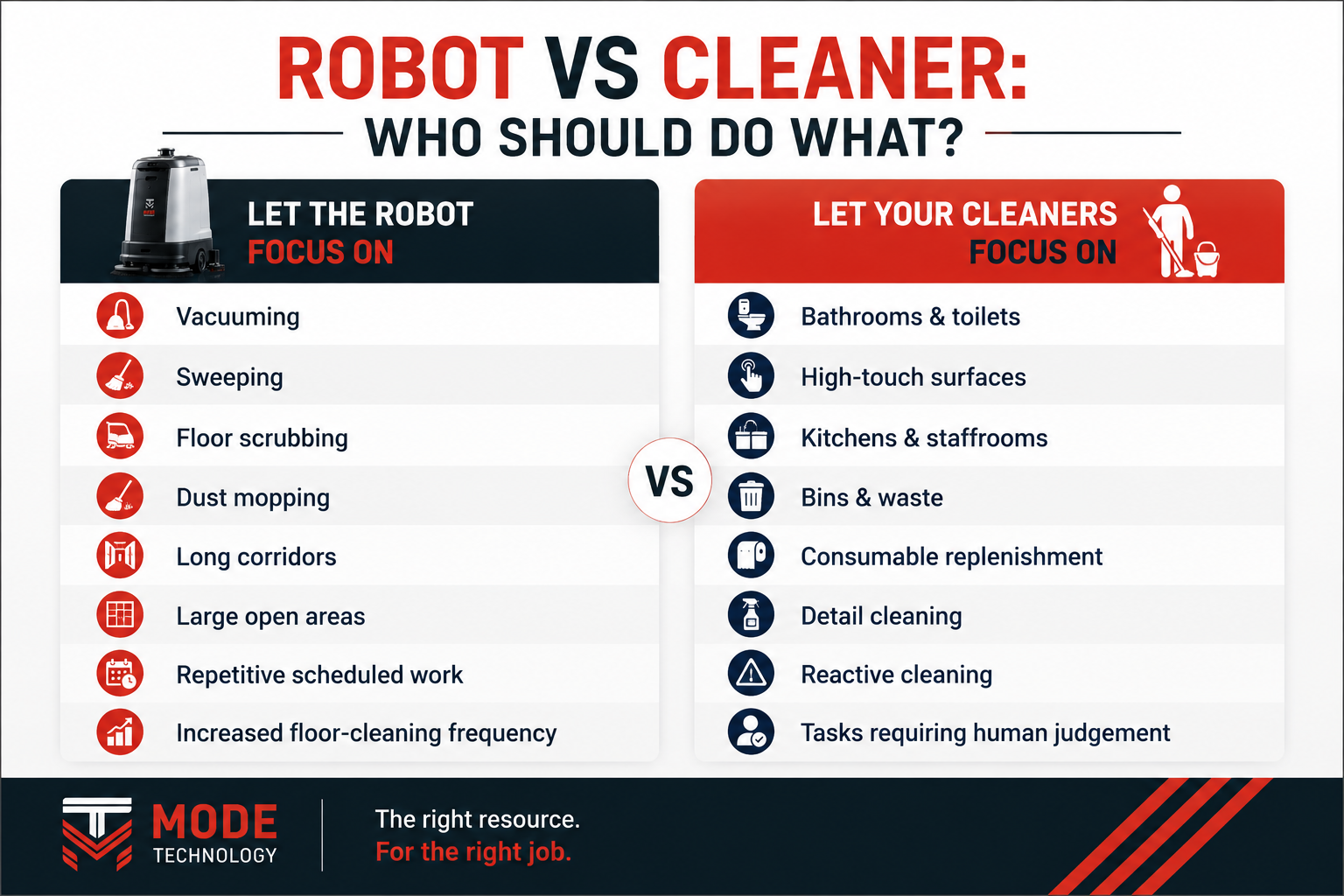
It's not really robot versus cleaner.
It's about recognising the strengths of each.
Robots are excellent at repetition, consistency and large-scale floor cleaning.
People are excellent at judgement, detail, hygiene-focused tasks and responding to what's happening around them.
Put the two together, and you can build a much smarter cleaning programme.
Could Your Cleaning Programme Work Smarter?
At Mode Technology, we provide commercial cleaning, cleaning robotics, servicing and hygiene solutions to organisations across New Zealand.
We can look at your current cleaning hours, floor area, cleaning schedule and environment to identify where your people are most valuable — and where automation could take over repetitive work.
The goal isn't to put a robot into every building.
It's to use the right resource for the right job.
Talk to Mode Technology about building a smarter commercial cleaning programme.