

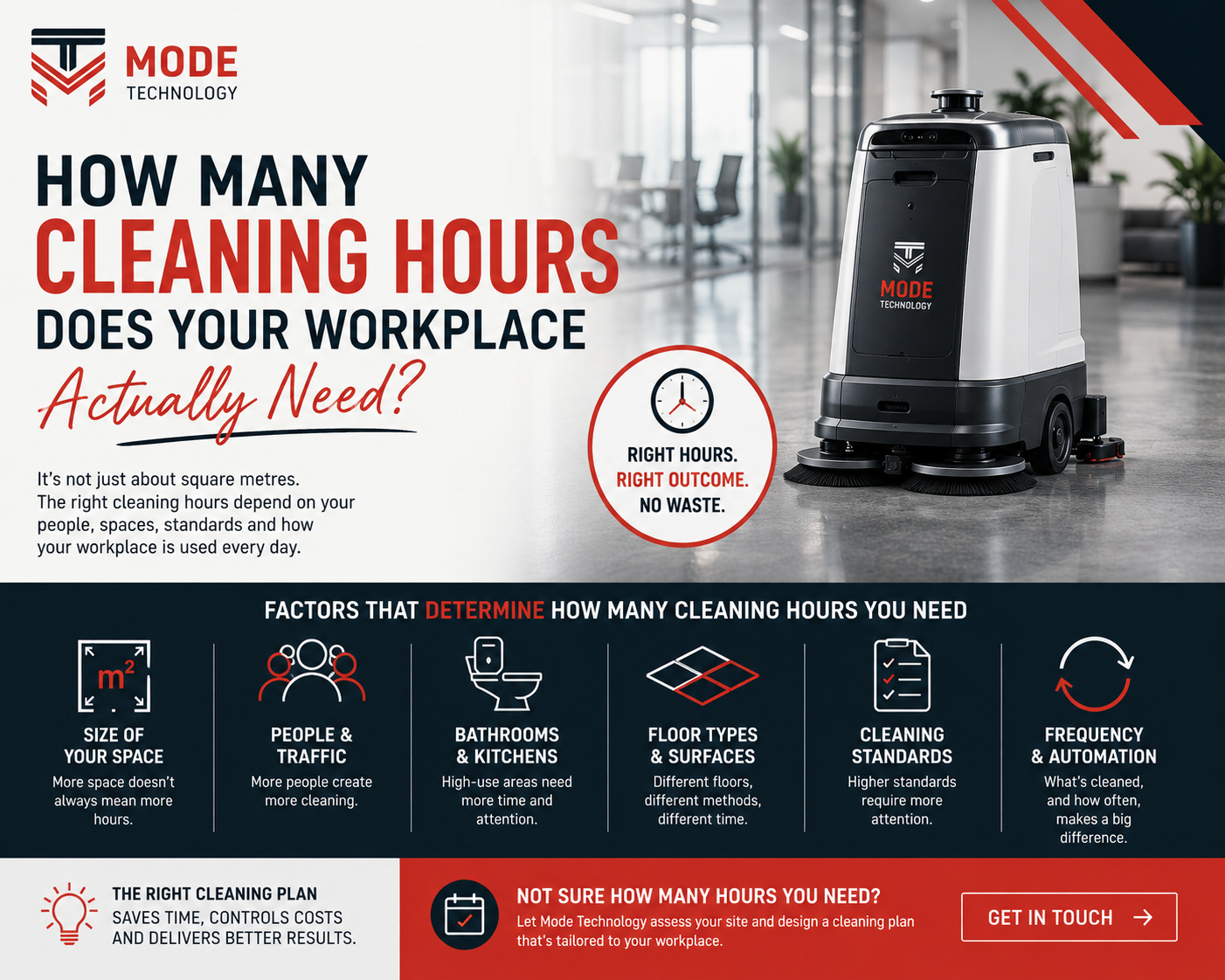
How Many Cleaning Hours Does Your Workplace Actually Need?
How long should it take ?
One of the first questions we're asked when pricing commercial cleaning is:
“How many hours do you think our site needs?”
It sounds like a simple question, but there isn't a standard answer.
Two workplaces can both be 1,500m² and require completely different amounts of cleaning. One might be a quiet office occupied by 30 people. The other could be a school, medical facility or busy workplace with hundreds of people moving through it every day.
The square metres matter, but they're only part of the equation.
At Mode Technology, when we assess a site, we're looking at what needs to be cleaned, how often it needs to be cleaned, how the building is used, and where cleaning time is actually going to be spent.
Here’s what really determines how many cleaning hours your workplace needs.
1. Start With the Size of the Building
Square metres give us a useful starting point.
Large open spaces can often be cleaned relatively efficiently. A 500m² open-plan office, for example, may be considerably quicker to clean than 500m² divided into dozens of individual rooms.
Every additional room potentially adds:
Doors and handles
Desks and furniture
Edges and corners
Bins
Touchpoints
Different floor surfaces
Obstacles that need to be cleaned around
So when someone tells us:
“Our building is 2,000m².”
Our next question isn't immediately, “How many cleaners do you need?”
It's:
“What's inside that 2,000m²?”
2. Bathrooms Consume More Cleaning Time Than Their Size Suggests
Bathrooms are a perfect example of why pricing cleaning purely by square metre doesn't work.
A bathroom may occupy only a small percentage of your building, but it can require a significant percentage of your cleaning time.
Cleaning can include toilets, urinals, basins, mirrors, partitions, dispensers, floors, touchpoints, bins and consumable replenishment.
Then there is frequency.
A bathroom used by ten office employees is very different from a bathroom used by hundreds of students, customers, residents or visitors each day.
When assessing a site, we want to know:
How many bathrooms are there? How many toilets and urinals? How many people use them? How frequently do they need servicing?
The number and usage of bathrooms can tell us more about required labour than the total size of the building.
3. Kitchens and Staffrooms Add Time Quickly
Kitchens are another relatively small area that can consume significant cleaning time.
Depending on your cleaning specification, this could include:
Benchtops
Sinks
Tables
Cabinet fronts
Appliances
Floors
Bins and recycling
High-touch surfaces
And then there's the biggest variable:
How do your people use the kitchen?
We've all seen both ends of the spectrum.
Some staffrooms are immaculate at the end of the day.
Others look like 40 people independently decided someone else was responsible for cleaning up after them.
Your cleaner can maintain a kitchen, but the behaviour of the people using it has a major impact on how long that takes.
4. How Many People Actually Use the Building?
Occupancy is a major factor.
Consider two identical 1,000m² offices.
Workplace A
30 employees.
Most staff work hybrid schedules.
Few visitors.
Workplace B
120 employees.
Everyone is on site five days a week.
Regular customers and visitors.
The floor area is identical. The cleaning requirement isn't.
More people generally means:
More bathroom use. More rubbish. More dishes. More fingerprints. More food. More floor traffic. More consumables.
That's why understanding occupancy and traffic patterns is critical when calculating cleaning hours.
5. What Type of Workplace Is It?
Not all commercial cleaning is the same.
A corporate office, school and retirement village shouldn't have the same cleaning programme simply because they're the same size.
Offices
Typically require regular vacuuming, bathrooms, kitchens, bins, touchpoints and periodic detail cleaning.
Schools & Education Facilities
Can have very high foot traffic, food on floors, multiple bathrooms, classrooms, corridors and significant differences between term-time and holiday cleaning.
Retail
Customer-facing areas generally require consistently high presentation standards, with entrances and floors often requiring frequent attention.
Retirement & Aged-Care Environments
Require greater attention to hygiene, infection prevention, bathrooms, communal spaces and high-touch surfaces.
Warehouses & Industrial Sites
May have fewer detailed areas but significantly larger floor spaces, dust and operational debris.
The type of facility fundamentally changes the cleaning workload.
6. Your Floor Type Matters
Not every square metre takes the same amount of time to clean.
Carpet needs vacuuming.
Hard floors may require vacuuming or sweeping before mopping.
Some floors require periodic machine scrubbing.
Entrances can bring in significant amounts of dirt and moisture, particularly during winter.
Then there are stairs.
A robot or commercial vacuum might move quickly through 500m² of unobstructed corridor, while a cleaner working through furnished offices, stairs and tight spaces will naturally cover considerably less area in the same time.
This is why we don't believe in simply saying:
“A cleaner should clean X square metres per hour.”
It depends entirely on what they're cleaning.
7. How Much Furniture and Clutter Is There?
This is frequently overlooked.
Compare an empty 100m² room with a 100m² office containing:
20 desks, 20 chairs, storage units, cables, rubbish bins, plants and personal belongings.
The cleaner still has 100m² of floor.
But they now have hundreds of objects to navigate around.
The same applies to classrooms, healthcare environments and hospitality spaces.
Usable cleaning productivity changes significantly depending on how accessible the area is.
8. What Standard of Cleaning Do You Expect?
This is perhaps the most important question.
What does “clean” actually mean to your organisation?
There is a significant difference between basic maintenance cleaning and a consistently high presentation and hygiene standard.
If you're expecting skirting boards, internal glass, detailed dusting, high-touch-point cleaning and regular periodic work, that needs to be included in the labour allowance.
One of the biggest mistakes we see is a cleaning specification that lists everything imaginable but doesn't allocate enough hours for anyone to realistically complete it.
Then everyone becomes frustrated.
The client thinks the cleaner isn't doing their job.
The cleaner feels they're being asked to complete five hours of work in three.
And the cleaning company spends its time responding to complaints rather than addressing the underlying issue:
There simply aren't enough hours allocated to the site.
9. Not Everything Needs to Be Cleaned Every Day
This is where a good Schedule of Duties becomes important.
Rather than attempting to clean everything every night, tasks should be allocated based on the frequency they actually require.
Daily: Bathrooms, kitchens, bins, high-traffic floors and key touchpoints.
Several times per week: General vacuuming, lower-traffic spaces and meeting rooms depending on usage.
Weekly: Detailed dusting, edges and less frequently used areas.
Monthly or periodically: High dusting, detailed internal glass, skirting, machine floor work and other deep-cleaning tasks.
A well-designed programme distributes the workload.
That means you're not paying someone to clean something simply because “it's on the list.”
You're paying them to clean it when it needs cleaning.
10. Don't Forget Daytime Cleaning Requirements
Some facilities can't realistically be serviced once per day.
A busy workplace might have bathrooms that need checking several times throughout the day.
Retail environments may need spill response.
Schools can require daytime bathroom servicing.
Large offices may need kitchen and meeting-room resets.
Retirement villages can have cleaning requirements throughout operating hours.
In these environments, the question isn't just:
“How many hours does the nightly clean take?”
It's:
“What cleaning support does this building need across the entire day?”
11. Robotics Can Change the Calculation
This is becoming an increasingly important part of how we design cleaning programmes at Mode Technology.
Traditionally, if a building required three hours of vacuuming every night, you allocated three hours of labour.
Today, that doesn't necessarily make sense.
Autonomous cleaning robots can perform repetitive floor-cleaning tasks such as:
Vacuuming, sweeping, dust mopping and scrubbing.
This means we can look at a site differently.
Instead of asking:
“How many cleaner hours does this building need?”
We can ask:
“How many HUMAN cleaning hours does this building actually need?”
That's an important distinction.
If a cleaner is spending 15 hours every week walking behind a vacuum through long corridors and open spaces, there may be an opportunity to automate some of those hours.
The cleaner can then focus on the work that requires people — bathrooms, kitchens, detailed cleaning, touchpoints and presentation.
For the right facility, this can create a much more productive people + robotics cleaning model.
So, How Many Cleaning Hours Does Your Workplace Need?
There isn't a magic formula.
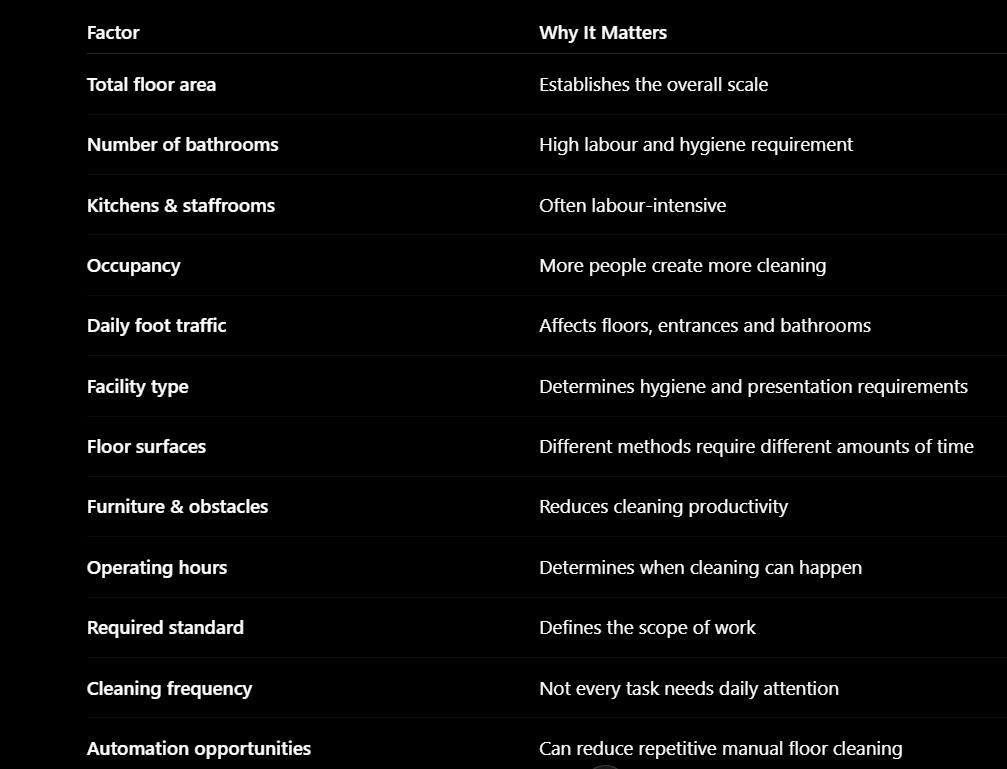
A proper cleaning assessment should consider:
And this is exactly why the cheapest cleaning quote isn't necessarily the best one.
If one company quotes 25 hours per week and another quotes 40 hours, it doesn't automatically mean the first company is more efficient.
They may simply be allowing fewer hours to complete the work.
The question you should be asking is:
“Can the cleaning specification we've agreed to realistically be completed within the hours you've quoted?”
Are You Paying for the Right Number of Cleaning Hours?
Sometimes we assess a site and find it needs more cleaning time.
Sometimes we find cleaning hours are being used inefficiently.
And sometimes there are repetitive tasks that could be automated, allowing the existing cleaning team to achieve significantly more without adding labour.
That's why Mode Technology looks at the whole cleaning programme, rather than simply supplying a cleaner at an hourly rate.
We consider the building, its occupants, cleaning specification, equipment, products, consumables and opportunities for autonomous cleaning.
The objective isn't necessarily to give you more cleaning hours.
It's to make sure you're getting the right cleaning outcome from the hours you're paying for.
How Many Cleaning Hours Does Your Workplace Actually Need?
Mode Technology can assess your site and help build a cleaning programme around your building, usage and required standard.
Whether you currently employ your own cleaners, use another cleaning company, or are considering a combination of commercial cleaning + robotics, we can help you understand what your site actually requires.