

Your Cleaning Team Is Short-Staffed Again. Now What?
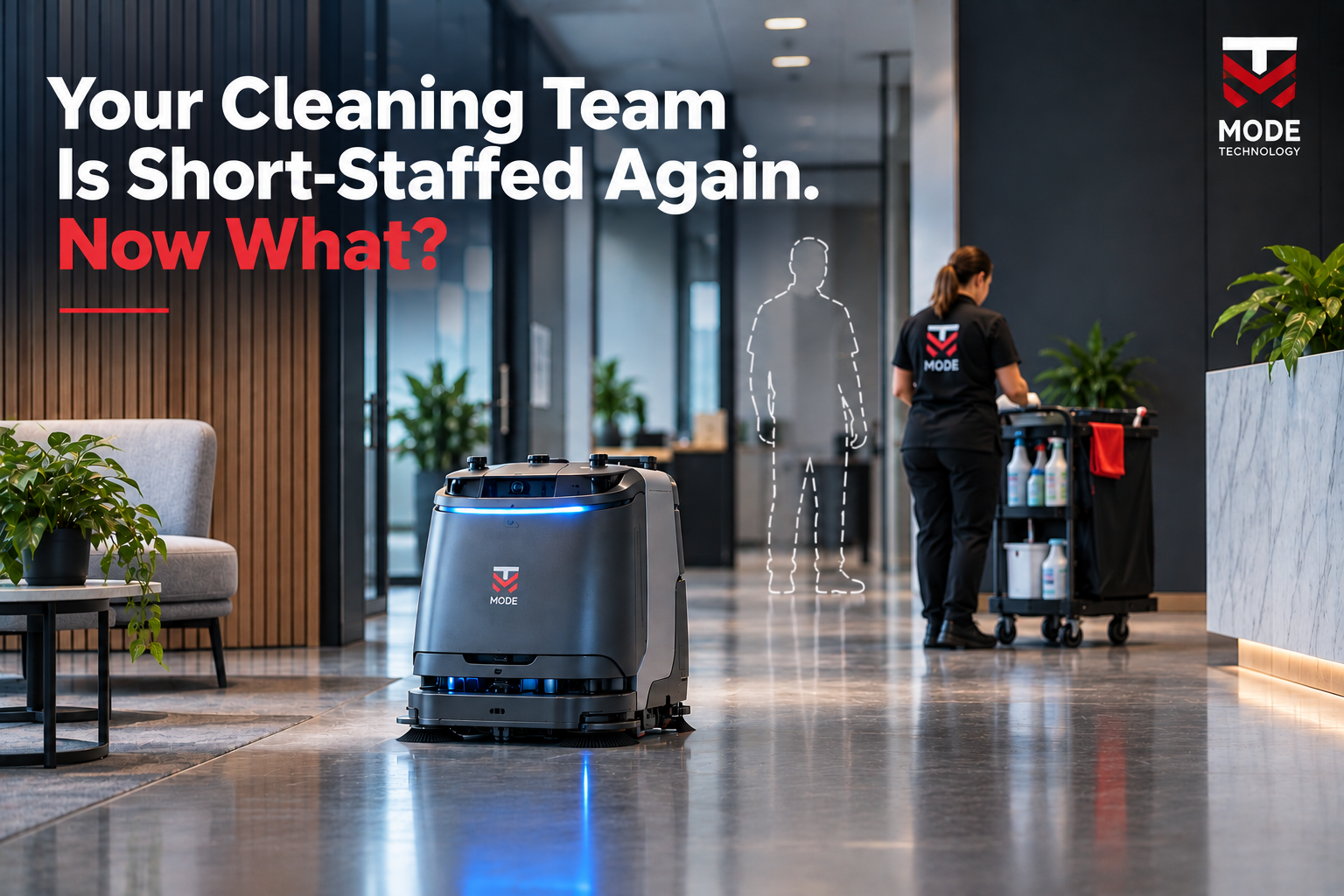
Your cleaning standard shouldn’t depend on whether everyone turns up.
Staff shortages happen.
Someone calls in sick. A cleaner leaves unexpectedly. Another person is covering two sites. Recruitment takes longer than expected, or the team simply has fewer hours available than the building really needs.
For businesses relying entirely on manual commercial cleaning, those staffing pressures can quickly become visible.
The toilets and kitchens still need to be cleaned. Bins still need emptying. High-touch surfaces still need attention.
So when there aren’t enough hours in the shift, something has to give.
And often, it’s the large, repetitive jobs — like vacuuming, sweeping and mopping hundreds of square metres of flooring — that compete with the detailed cleaning only a person can do.
At Mode Technology, we think there’s a smarter way to build resilience into commercial cleaning.
Not by replacing cleaners with robots, but by making sure cleaners don’t have to do everything themselves.
Cleaning has traditionally relied almost entirely on people
Commercial cleaning is a people-intensive industry.
And people are one of its greatest strengths.
A good cleaner notices things.
They see the fingerprints on the glass door. They notice that a bathroom needs extra attention. They know when the kitchen needs more than a quick wipe. They spot a leaking tap, an overflowing bin or a soap dispenser that is nearly empty.
That human judgement is incredibly valuable.
But traditional cleaning models also rely on people for highly repetitive tasks that technology can now help with.
Think about a cleaner vacuuming the same large office floor night after night.
Or walking up and down a showroom with a mop.
Those jobs still need doing — but does the person necessarily need to be the one doing all of them?
What happens when someone doesn't turn up?
Imagine your cleaning team has four hours to service a building.
Then one cleaner calls in sick.
The building hasn't suddenly become smaller.
There aren't fewer toilets.
The kitchen hasn't disappeared.
The bins don't stop filling up.
There are simply fewer human hours available to complete the same amount of work.
A cleaner or supervisor then has to make decisions about what gets prioritised.
Usually, essential hygiene areas come first — and rightly so.
But over time, reducing the frequency of other tasks can affect the overall presentation and standard of the facility.
This is where automation can provide something incredibly valuable:
A consistent baseline of cleaning that doesn't disappear when staffing changes.
The robot doesn't call in sick
A commercial cleaning robot isn't a replacement employee.
It is a piece of equipment designed to perform specific cleaning tasks consistently.
Once mapped and scheduled appropriately, robotic cleaners can vacuum, sweep, dust mop or scrub suitable floor areas according to the cleaning programme established for the site.
That might be overnight.
It might be between attended cleaning visits.
And depending on the facility, it could operate multiple days each week.
So when there is pressure on the cleaning team, the large floor areas don't necessarily need to be sacrificed.
The robot can continue doing the job it was scheduled to do.
That leaves the available people to focus on the areas where they add the greatest value.
Imagine the difference on a difficult night
Your cleaner arrives and discovers they're covering for someone who is away.
Under a completely manual model, they may look at a long list of tasks and wonder how they're going to fit everything in.
Under a hybrid model, the situation looks different.
The robot can take care of suitable floor areas while the cleaner works through:
bathrooms and washrooms
kitchens and staffrooms
bins and waste
desks and surfaces
glass and touchpoints
meeting rooms
consumable replenishment
presentation and detailed cleaning.
The cleaner hasn't become less important.
Their time has become more valuable.
And that's one of the biggest misconceptions about cleaning automation.
Automation isn't about removing people
When businesses first hear "cleaning robot", it's understandable that one of the first questions is:
“Does that mean fewer cleaners?”
That isn't how we believe automation should be approached.
At Mode Technology, we look at where people are spending their time and ask whether technology could take over some of the repetitive work.
If it can, what could the cleaning team achieve with that time instead?
Could bathrooms receive more attention?
Could kitchens be cleaned more thoroughly?
Could areas that are regularly missed finally be added to the schedule?
Could the cleaner finish the shift without rushing?
Could floor cleaning happen more frequently than the customer's labour budget would traditionally allow?
Those are much more useful questions.
The objective isn't simply to reduce labour.
It's to increase cleaning capacity.
Consistency matters more than perfection once a week
There's another issue with traditional cleaning contracts.
Sometimes a building looks fantastic immediately after its major clean — and progressively worse until the next one.
For a workplace operating five, six or seven days a week, that's not necessarily the best outcome.
Customers don't only visit on cleaning days.
Employees don't only use the office after it has just been vacuumed.
A showroom doesn't stop receiving foot traffic because the cleaner isn't due until tomorrow.
Robotics creates the opportunity to spread certain cleaning activities across the week.
Instead of trying to make everything perfect during two large cleaning shifts, appropriate floor care can potentially happen more regularly.
That creates something businesses often value more than an occasional intensive clean:
Consistency.
But someone still needs to manage the robot
There's an important point here.
Buying a robot and putting it in the corner of your building doesn't automatically create a cleaning solution.
Someone needs to:
map it.
Schedule it.
Monitor it.
Maintain it.
Service it.
Respond if something changes in the environment.
And make sure the robot's work fits properly around what the human cleaning team is doing.
That's why Mode Technology's approach isn't simply about selling customers a machine.
We can integrate robotics into the wider commercial cleaning service and manage the relationship between the people, the technology and the cleaning schedule.
For the customer, it should feel like one service.
Not another piece of technology they have to manage.
Better for cleaners, too
There's another side to this conversation that matters to us.
Commercial cleaning is physical work.
Vacuuming large areas, pushing equipment and repeatedly mopping floors can be tiring and repetitive.
If technology can take some of that workload away while allowing cleaners to concentrate on detailed tasks, that's a positive outcome for the people doing the work too.
Good automation shouldn't make people less valuable.
It should remove some of the work that adds the least value to their time.
Building resilience into your cleaning contract
Businesses build redundancy into plenty of other areas.
They back up their data.
They have spare equipment.
They develop contingency plans.
They don't want an important business function to depend entirely on one person or one piece of equipment.
Cleaning should be thought about in much the same way.
A hybrid commercial cleaning model gives a facility another layer of resilience.
If staffing is under pressure, automated cleaning can continue.
If a robot requires servicing, the human cleaning team is still there.
Neither side has to carry the entire workload alone.
People support the technology. Technology supports the people.
That's a much stronger model than relying entirely on either one.
Your cleaning standard shouldn't depend on whether everyone turns up
There will always be sick days.
There will always be staff turnover.
There will always be busy periods and unexpected challenges.
The goal shouldn't be pretending those things won't happen.
It should be designing a cleaning service that can handle them when they do.
That's what we believe the next generation of commercial cleaning looks like.
Not cleaner versus robot.
Cleaner plus robot.
Supported by the right equipment, consumables, service management and technology.
Because ultimately, your employees and customers don't care who — or what — cleaned the floor.
They just expect it to be clean.
Could your cleaning service be more resilient?
If staffing shortages or inconsistent cleaning are affecting your workplace, Mode Technology can assess your existing cleaning programme and identify where automation could support your cleaning team.
We look at what needs a human touch, what can be automated and how the two can work together to provide a more consistent service.
Commercial Cleaning. Robotics. Hygiene & Consumable Supplies.
Mode Technology
Safe by design. Efficient by nature. Scalable by choice.