

Your Cleaner Comes Twice a Week. What Happens the Other Five Days?
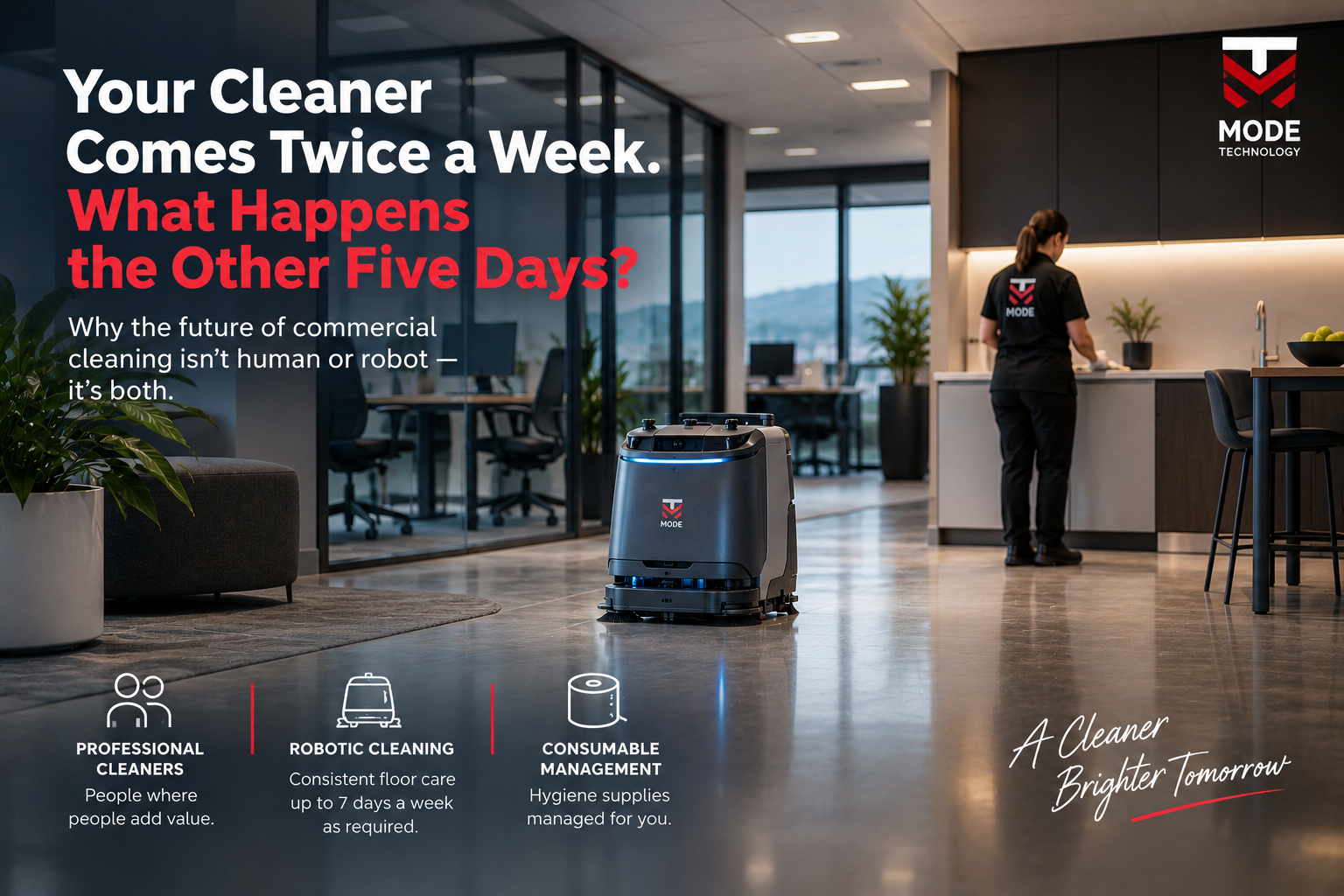
Why the future of commercial cleaning isn’t human or robot, it’s both.
For decades, commercial cleaning has largely been sold the same way: a cleaner comes to your site a set number of times each week, works for an agreed number of hours, completes a schedule of duties and leaves.
But businesses don’t only operate on cleaning days.
Your staff still walk through the office. Customers still enter the showroom. Dust still settles. Floors still collect dirt. Bathrooms still need supplies. Bins fill up, and hand towels and toilet paper run out.
So perhaps the better question isn’t:
“How many hours of cleaning are we paying for?”
It’s:
“How do we keep our facility consistently clean and well presented throughout the week?”
At Mode Technology, we believe that requires a different approach.
People where people add value. Automation where it makes sense.
We don’t believe robots should replace cleaners.
We also don’t believe skilled cleaners should spend the majority of their time walking backwards and forwards across large floor areas doing repetitive tasks that technology can support.
The most effective commercial cleaning model combines the two.
A trained cleaner can do things a robot simply can’t.
They can clean and sanitise bathrooms, wipe desks and surfaces, clean kitchens, empty bins, manage consumables, spot issues and pay attention to the little details that determine whether a workplace actually feels clean.
Robotic cleaning technology can then take on repetitive, time-consuming floor care.
Vacuuming. Sweeping. Dust mopping. Scrubbing.
And it can do it consistently, including on days when your cleaning team isn't scheduled to attend.
That changes the equation completely.
Your cleaning contract might say two days. Your robot doesn't have to.
Imagine an office, showroom or commercial facility with cleaners attending on Tuesday and Thursday evenings.
Under a traditional cleaning contract, the floors may receive their major clean twice a week.
With a hybrid Mode Technology service, our cleaning team can attend on those same two evenings, but a robotic cleaner can potentially operate throughout the rest of the week according to the site's requirements.
Monday.
Wednesday.
Friday.
And, where appropriate, weekends too.
Instead of trying to squeeze every task into a limited number of labour hours, automation creates additional cleaning capacity.
We've seen this first-hand across our New Zealand deployments. In fact, more than 90% of the robots Mode has deployed are completing cleaning that wasn't consistently being done before — often because there simply wasn't enough labour time or budget available to cover every large floor area as frequently as businesses would like.
That is an important distinction.
Automation doesn't necessarily mean fewer people. It can mean more cleaning.
Give your cleaners time to actually clean
There is another benefit that isn't talked about enough.
Every hour a cleaner spends vacuuming a large open-plan office or manually mopping hundreds of square metres is an hour they can't spend somewhere else.
Take much of that repetitive floor care away and suddenly the same cleaner has more time to focus on bathrooms, kitchens, touchpoints, glass, presentation and detail.
The technology does what technology does well.
People do what people do well.
Neither has to do everything.
And that is where we believe the real value of robotics sits.
Cleaning is also about creating a safe workplace
Floor care isn't only about presentation.
WorkSafe New Zealand identifies slippery floors, spills, clutter and poorly maintained surfaces as contributors to workplace slips, trips and falls. Its guidance also specifically recommends considering cleaning at times when fewer people are present.
Technology gives businesses more flexibility around when some cleaning tasks happen.
Rather than having every task compete for the same small service window, appropriate robotic floor cleaning can be scheduled around the way a facility operates.
It's another reason we believe commercial cleaning should be designed around the site, rather than simply around a fixed number of labour hours.
And then there's the toilet paper...
Cleaning is only one part of maintaining a workplace.
Someone also has to make sure there is toilet paper.
And hand towels.
And soap.
And bin liners.
And cleaning products.
It sounds simple until somebody walks into a bathroom and discovers the dispenser is empty.
That's why Mode Technology's commercial cleaning service can also include the supply and management of hygiene and consumable products.
Our team is already servicing the facility. Rather than asking the customer to monitor stock, place orders and manage another supplier, we can help take care of that as part of the wider service.
It brings three areas together:
Commercial Cleaning + Robotics + Hygiene & Consumable Supplies.
One provider, working across the whole cleaning environment.
So what are you actually buying?
This is where we think the commercial cleaning conversation needs to change.
Businesses shouldn't necessarily be asking:
“How cheaply can I buy four hours of cleaning?”
They should be asking:
“What cleaning outcome can I achieve for my budget?”
There is a significant difference.
A traditional contract might give you a certain number of labour hours.
A hybrid model can give you human cleaning hours plus additional autonomous cleaning hours throughout the week.
It can also give your cleaners more time for detailed work, provide greater consistency across large floor areas and simplify the management of everyday hygiene supplies.
The result isn't about having the flashiest robot in the building.
It's about getting more cleaning done.
Robots aren't right for every site
We also don't believe in putting a robot somewhere simply because we can.
Automation works best where there are suitable areas and repetitive tasks that justify it — large offices, retail environments, warehouses, schools, retirement villages, sports facilities and other commercial spaces can all present opportunities.
The right starting point is understanding the building.
What is being cleaned now?
How often?
Where are cleaners spending most of their time?
Which tasks require a person?
Which tasks could be automated?
And, importantly, what isn't being cleaned as often as you'd actually like?
From there, we can design the right mix of people and technology.
The future isn't cleaner vs robot
There's plenty of conversation about automation replacing people.
That's not how we see it.
At Mode Technology, our approach is about using automation to support people and redesigning the cleaning service around what each does best.
Our cleaners bring judgement, care and attention to detail.
Our robots bring consistency, coverage and the ability to perform repetitive floor care without consuming valuable cleaning-team hours.
Our hygiene and consumable service helps make sure the everyday essentials are taken care of too.
Put them together and commercial cleaning becomes something quite different from somebody simply arriving twice a week with a vacuum cleaner.
It becomes a managed facility-cleaning solution.
Safe by design. Efficient by nature. Scalable by choice.
Could your cleaning contract be working harder?
If you're reviewing your commercial cleaning contract, don't just compare hourly rates.
Let us look at your site and show you where a combination of people, robotics and smarter consumable management could deliver more from the same cleaning budget.
Talk to Mode Technology about a site assessment and discover what your cleaning service could look like when humans and automation work together.